
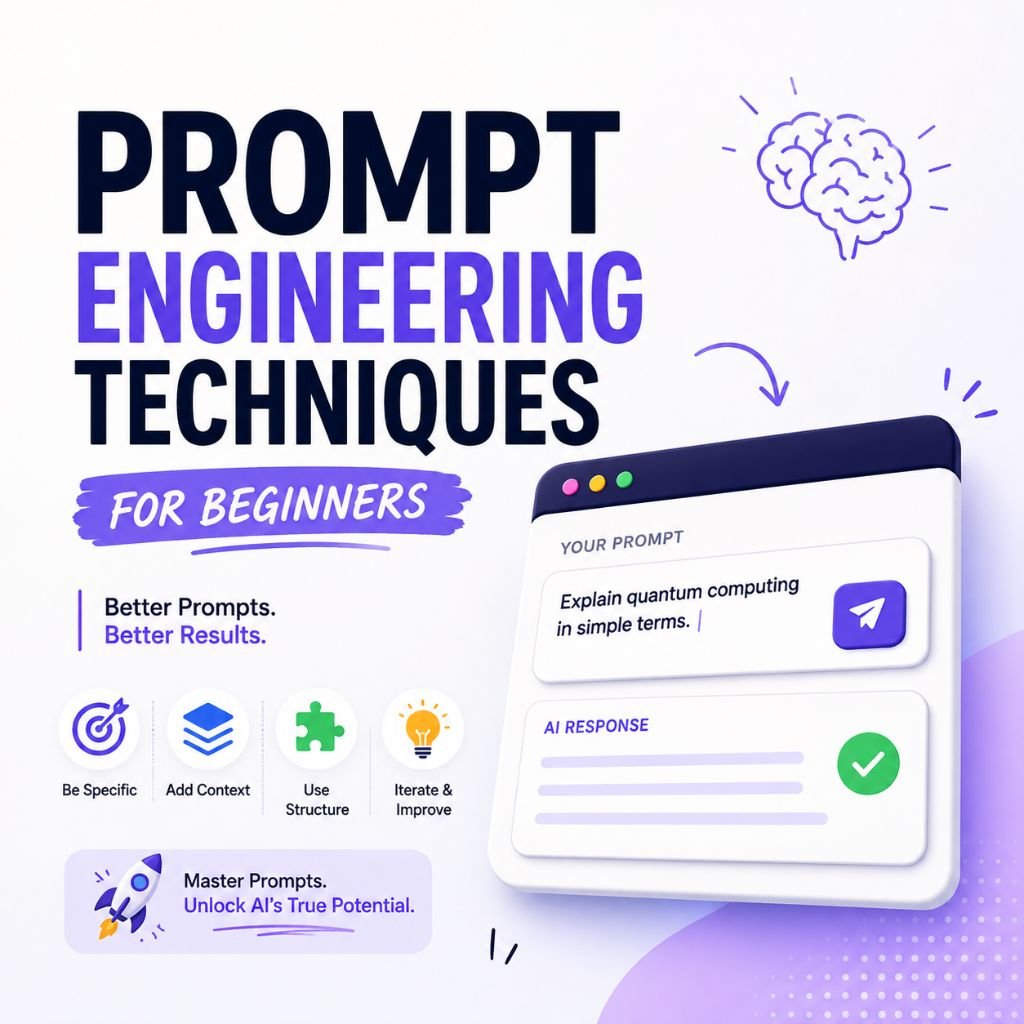

Mastering prompt engineering techniques for beginners has quickly become one of the most high-leverage skills in the modern digital economy. Whether you are a freelance writer in London, a digital marketer in San Francisco, an agency founder in Toronto, or an aspiring tech creator based in India’s vibrant tech hubs (Bengaluru, Hyderabad, Delhi, Mumbai), knowing how to communicate effectively with artificial intelligence models separates mediocre results from extraordinary output.
Most people treat large language models (LLMs) like a basic search engine—typing vague one-sentence questions and feeling disappointed when the response sounds generic or robotic. However, models like GPT-4o, Claude 3.5 Sonnet, and open-source models like Llama 3 do not lack capability; they lack context and clear instructions.
In this practical guide, you will learn the fundamental frameworks and actionable prompt engineering principles that will instantly elevate the quality, accuracy, and reliability of your AI workflows.
Why Learning Prompt Engineering Techniques for Beginners Matters in 2026
Artificial intelligence tools have evolved from novelty chatbots into mission-critical engines for daily business operations. Today, companies rely on AI to draft client proposals, write software code, analyze financial spreadsheets, and manage omnichannel customer support.
Understanding core prompt engineering techniques for beginners bridges the gap between generic, robotic answers and sharp, production-ready outputs. When you provide structured instructions, you reduce the model’s guessing space, minimize factual errors (hallucinations), and force the AI to reason through complex problems before presenting an answer.
Furthermore, these prompt structuring principles apply universally. Whether you are using ChatGPT, Claude, Microsoft Copilot, or running self-hosted models locally via Ollama, the underlying communication logic remains identical.
5 Proven Prompt Engineering Techniques for Beginners That Actually Work
To move beyond basic one-line prompts, incorporate these five field-tested techniques into your daily workflow.
1. Persona and Role Framing (The Identity Layer)
Among the foundational prompt engineering techniques for beginners, persona and role framing is the easiest to implement and yields immediate improvements. By assigning a specific professional role, tone, and audience context to the AI, you instantly steer the model’s vocabulary and reasoning depth.
- Basic Prompt: “Write an email explaining why SEO is important.”
- Engineered Prompt: “You are a senior digital marketing director with over 10 years of performance marketing experience. Write a concise, persuasive email to a non-technical local business owner explaining why investing in local SEO will increase their inbound customer phone calls. Keep the tone professional, avoid technical jargon, and use one real-world retail example.”
2. Few-Shot In-Context Learning (Pattern Setting)
Few-shot prompting is one of the most reliable prompt engineering techniques for beginners when you need strict formatting, custom classification, or a distinctive brand voice. Instead of merely describing what you want, you provide 2–3 concrete input/output examples before asking your final question.
Classify the customer sentiment of the following reviews into: Positive, Neutral, or Urgent Issue.

Example 1:
Review: "The package arrived two days late, but the shirt fits nicely."
Sentiment: Neutral

Example 2:
Review: "My credit card was charged twice and nobody is responding on chat!"
Sentiment: Urgent Issue

Example 3:
Review: "Best customer service I have experienced all year. Highly recommended!"
Sentiment: Positive

Review to classify:
Review: "I've been trying to reset my password for three hours and the link is expired."
Sentiment:
3. Chain-of-Thought (Step-by-Step Reasoning)
When dealing with multi-step logic, data analysis, or complex problem-solving, AI models often make arithmetic or logical errors if they try to guess the final answer immediately. Forcing the model to “think aloud” step-by-step dramatically increases accuracy.
- Actionable Trigger Phrase: “Think step by step before generating the final answer. First, list your assumptions, second, calculate the intermediate values, and third, state the final recommendation.”
- Why It Works: It allows the model to generate reasoning tokens first, which serve as foundational context for the final conclusion.
4. Output Formatting & Delimiter Anchoring (JSON / Markdown Tables)
Language models perform best when instructions are cleanly separated from raw reference data. Use clear delimiters (such as ###, ---, or XML-style tags like <context> and </context>) to prevent the model from confusing instructions with reference text.
- Example Template:
Task: Extract key competitor data from the provided text and format it into a clean Markdown table.

Columns required: Company Name | Target Audience | Pricing Model | Main Advantage

Text to analyze:
<data>
[Paste your raw customer notes, competitor website text, or article snippets here]
</data>
5. Negative Constraints & Guardrails (Eliminating Fluff)
By default, language models tend to be overly polite, wordy, and repetitive. Explicitly telling the AI what not to do is just as important as telling it what to do.
- Essential Guardrail Rules to Include:
- “Do not use filler phrases such as ‘In conclusion’, ‘Delve into’, or ‘It is important to remember’.”
- “Do not exceed 150 words.”
- “If the provided context does not contain the answer, state ‘Information not available in source’ rather than guessing.”
The C-R-E-A-T-E Prompting Formula for Everyday Work
To make these principles easy to remember during busy workdays, use the C-R-E-A-T-E formula whenever you construct a prompt:
| Letter | Element | Purpose |
| C | Context | Background information about the business, audience, or situation |
| R | Role | The exact expert persona the AI should adopt |
| E | Explicit Task | The clear, unambiguous action you want completed |
| A | Audience | Who will be reading or using the final output |
| T | Tone & Constraints | Style guidelines, length limits, and negative constraints |
| E | Examples | 1–2 sample outputs showing the exact desired formatting |
By combining these prompt engineering techniques for beginners into reusable prompt templates, you can automate complex marketing, coding, and research tasks with high predictability.
Global Applications for Remote Freelancers and Digital Marketers
Whether you are crafting high-converting ad copy for e-commerce brands in North America and the UK, optimizing corporate reports for clients in Europe, or running lead generation campaigns across fast-expanding digital markets in India and Southeast Asia, structured prompting is a critical competitive advantage.
By saving your highest-performing prompt templates in tools like Notion or Obsidian, you create reusable digital assets that allow you to deliver client deliverables in minutes rather than hours.
Frequently Asked Questions About Prompt Engineering Techniques for Beginners
Q: Do I need a technical or coding background to learn prompt engineering techniques for beginners?
No coding background is required. Prompt engineering is primarily about clear, structured, natural-language communication. If you can explain a task clearly to a human junior assistant, you can write effective prompts for an AI model.
Q: What is the difference between a system prompt and a user prompt?
A system prompt sets the permanent overarching behavior, identity, and safety guardrails of the AI assistant (e.g., “You are an assistant for aiguruji.tech”). A user prompt is the specific task or question submitted during an individual conversation.
Q: Which AI tool is best for practicing prompt engineering?
You can practice for free using web interfaces like ChatGPT, Claude.ai, or Google Gemini. If you prefer running local, private models on your own computer, Ollama paired with Open-WebUI provides an exceptional zero-cost sandbox environment.
Conclusion & Action Steps
Prompt engineering is not about learning secret magic words; it is about providing clear context, concrete examples, structured constraints, and step-by-step instructions. By applying persona framing, few-shot examples, and the C-R-E-A-T-E formula, you will immediately notice a dramatic improvement in your AI-assisted work.
Pick one upcoming task today—whether writing an email, summarizing a report, or planning an ad campaign—and apply these frameworks. For more step-by-step guides, free prompt libraries, and automation playbooks, visit aiguruji.tech.


Pingback: 5 Best System Prompts for Digital Marketers
Pingback: How to Use ChatGPT Astra: The Complete Beginner's Guide