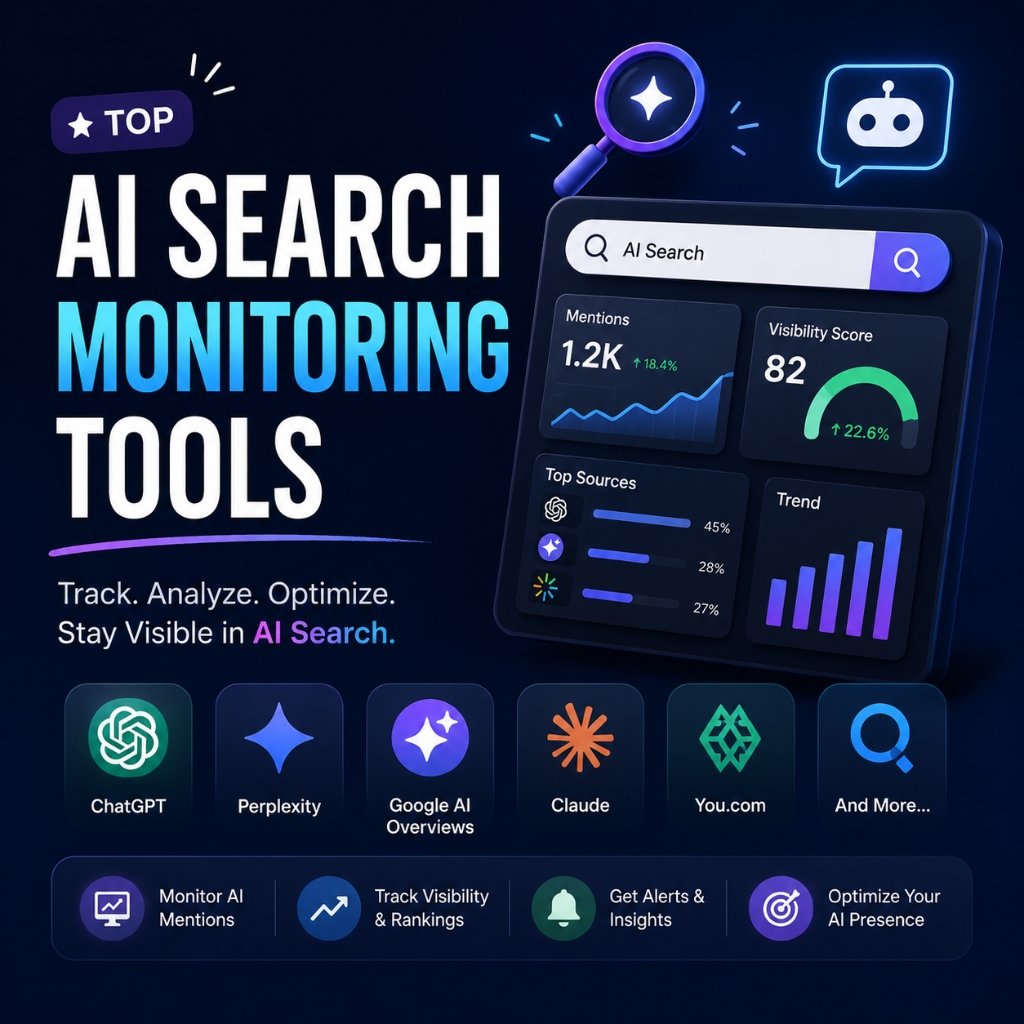

Discovering the top ai search monitoring tools has become a critical priority for brands, marketers, and creators who want to track how their business appears across modern generative search engines. The way consumers and enterprise buyers research products has fundamentally shifted. Rather than typing fragmented keywords into traditional search bars and browsing through pages of blue links, millions of daily users now ask comprehensive, conversational questions to platforms like ChatGPT Search, Perplexity AI, Google AI Overviews, Microsoft Copilot, and Google Gemini.
In this practical guide, you will learn why AI search monitoring is vital, explore the best monitoring software platforms available in 2026, and discover how to track your brand’s citations and share of voice.
Why Tracking Top AI Search Monitoring Tools Matters in 2026
Traditional rank-tracking tools measure keyword positions on a static Google search engine results page (SERP). However, generative AI engines do not produce static rank lists; they dynamically synthesize conversational answers on the fly using Retrieval-Augmented Generation (RAG).
Investing in top ai search monitoring tools enables companies to track brand sentiment, capture prompt-level market share, and identify missing citation links before competitors take over the conversation across conversational search engines.
Key reasons why monitoring AI engines is essential include:
- Dark Search Visibility: Traditional analytics tools like Google Search Console cannot tell you if ChatGPT or Perplexity recommended your brand in a private user chat.
- Citation Tracing: AI monitoring software identifies the exact third-party blogs, review websites, and industry forums that large language models crawl to generate answers.
- Sentiment and Accuracy Auditing: Language models occasionally produce hallucinations or reference outdated pricing. Monitoring alerts you immediately when an AI misrepresents your products or services.
7 Top AI Search Monitoring Tools to Track Brand Citations
To help your team choose the right platform for tracking generative search visibility, here are the seven leading solutions ranked by capabilities and use cases:
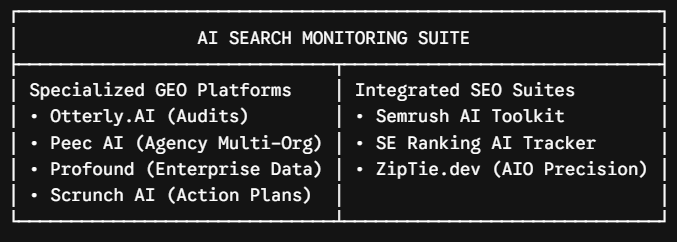
1. Otterly.AI (Best for Automated Multi-Engine Audits)
Otterly.AI is an intuitive, specialized monitoring solution that tracks brand mentions across ChatGPT, Perplexity, and Google AI Overviews. It automatically runs scheduled buyer prompts (such as “What is the best CRM for remote marketing agencies?”), logs whether your website is cited, and evaluates the sentiment of the response.
- Key Features: Automated prompt tracking, sentiment analysis, domain-level citation audits, and competitor benchmarking.
- Best For: Small-to-medium businesses and content creators wanting an affordable, dedicated monitoring dashboard.
2. Peec AI (Best for Marketing Agencies & Multi-Client Projects)
Among the top ai search monitoring tools for agencies, Peec AI and Otterly.AI stand out for automated multi-engine prompt audits and granular client reporting. Peec AI offers multi-region tracking, allowing agencies to see how a brand appears to users in different geographic countries.
- Key Features: Multi-brand workspace switching, detailed citation source breakdowns, and prompt share-of-voice calculations.
- Best For: Digital marketing and PR agencies managing AI search visibility across multiple client accounts.
3. Semrush AI Visibility Toolkit (Best for Integrated SEO & GEO)
For established marketing teams, these integrated platforms rank among the top ai search monitoring tools by blending traditional SERP tracking with generative engine analysis inside a unified workflow. Semrush connects AI mention tracking directly with its existing Keyword Overview and Backlink Audit databases.
- Key Features: Side-by-side comparison of traditional Google rankings versus AI Overview inclusions, historical citation tracking, and gap analysis.
- Best For: Enterprise teams already using the Semrush ecosystem for organic growth.
4. Profound / AthenaHQ (Best for Enterprise Analytics & Custom Datasets)
Profound is an enterprise-grade AI search analytics platform built for high-volume corporate brands. It analyzes millions of synthetic prompt interactions across Claude, Gemini, Copilot, and ChatGPT, delivering comprehensive statistical models of brand visibility and market share.
- Key Features: Deep API access, raw prompt data exports, enterprise compliance, and executive-level share-of-model dashboards.
- Best For: Fortune 500 corporations and venture-backed SaaS companies.
5. SE Ranking AI Search Toolkit (Best for Mid-Market Search Agencies)
SE Ranking provides a dedicated AI Overview and Perplexity visibility module that tracks changes in generative search responses over time, alerting marketers whenever their brand loses a cited link.
- Key Features: Automated alert triggers for dropped citations, historical timeline graphs, and competitor comparison charts.
- Best For: In-house SEO managers looking for cost-effective tracking paired with core technical site auditing.
6. ZipTie.dev (Best for Deep Google AI Overviews Tracking)
ZipTie is a specialized monitoring engine focused specifically on Google AI Overviews and Search Generative Experience (SGE). It captures pixel-by-pixel screenshots of AI Overviews across thousands of target keywords, highlighting which URLs are referenced in the citation carousel.
- Key Features: Pixel-accurate SERP snapshot archiving, carousel link attribution, and indexation checks.
- Best For: Technical SEOs conducting in-depth algorithmic research on Google’s generative search behavior.
7. Scrunch AI & Promptwatch (Best for Actionable Optimization Insights)
While many tools only show where you rank, Scrunch and Promptwatch focus on execution. They analyze the structural reasons why a competitor was cited instead of your website and generate actionable content briefs to help you close the gap.
- Key Features: Content optimization recommendations, entity missing-gap reports, and automated outreach target lists.
- Best For: Content marketing teams actively updating old blog articles for Generative Engine Optimization (GEO).
Core Features to Look for in Top AI Search Monitoring Tools
When evaluating the top ai search monitoring tools, your marketing department should look for prompt share-of-voice reporting, sentiment tagging, and actionable content optimization recommendations to ensure you invest in software that drives tangible organic growth:
| Feature Requirement | Why It Matters |
| Multi-Engine Coverage | Must monitor ChatGPT, Perplexity, Gemini, Claude, and Google AI Overviews |
| Citation URL Tracing | Shows the exact external websites and forums AI engines use as sources |
| Prompt Customization | Allows you to test natural, conversational, multi-sentence buyer queries |
| Competitor Share of Voice | Quantifies how often competitors are recommended over your brand |
| Automated Dropped-Citation Alerts | Sends notifications when your brand drops out of an AI-generated answer |
Global & Regional Brand Monitoring Strategy
AI search engines tailor their generated answers based on user location, regional domain authority, and localized business data. A query for “top performance marketing consultants” asked in London will produce completely different citation sources than the same prompt entered in Bengaluru or Chicago.
When configuring your monitoring tools, ensure you test localized prompts with geographic modifiers. Track whether regional directories, local case studies, and localized Schema markup help your brand capture AI citations in your specific target markets.
Frequently Asked Questions About Top AI Search Monitoring Tools
Q: How do top ai search monitoring tools track brand mentions inside closed AI models?
These platforms programmatically execute thousands of targeted, natural-language prompts via official APIs and headless browsers, parse the generated responses for entity mentions and citations, and aggregate the findings into structured analytics dashboards.
Q: Can small businesses afford AI search tracking software?
Yes. While enterprise suites like Profound target large corporations, modern self-serve tools like Otterly.AI and Peec AI offer entry-level monitoring tiers starting under $30 to $50 per month.
Q: How often should a marketing team audit its AI search visibility?
Fast-moving brands should configure weekly automated tracking for high-intent commercial prompts, paired with monthly deep-dive audits into competitor citation shifts and new AI search releases.
Conclusion & Action Steps
As conversational search continues to handle an increasing percentage of global web discovery, monitoring how artificial intelligence describes your business is no longer optional. By deploying dedicated AI search monitoring tools, you can safeguard your brand reputation, track valuable citation links, and optimize your content for the future of search.
Choose one tool from this guide, set up your primary brand keywords and competitor names, and run your first AI visibility audit today. For more Generative Engine Optimization tutorials, tool breakdowns, and marketing automation playbooks, visit aiguruji.tech.