
Artificial intelligence is moving beyond simple chatbots and text generation. Today, AI systems are becoming smarter, capable of handling tasks, making decisions, using different tools, and completing complex workflows with minimal human involvement. This exciting shift is known as Agentic AI, and it’s quickly becoming one of the most talked-about developments in the AI industry.
If you’re planning to learn Agentic AI in 2026, now is a great time to get started. Businesses are exploring ways to use AI agents for customer support, marketing automation, research, data analysis, and even software development. Instead of giving an AI chatbot instructions for every single step, you can build AI agents that work toward a goal, decide what actions to take, and use connected tools to get things done.
And here’s the interesting part: you don’t need to be an AI researcher or an expert in advanced mathematics to begin learning Agentic AI. Having a basic understanding of programming, APIs, and how AI models work can give you a good starting point.
Unlike traditional machine learning, where much of the focus is on training models and understanding complex algorithms, Agentic AI is more about connecting existing AI models with tools, designing workflows, and building systems that can perform useful tasks reliably.
Whether you’re a student, software developer, freelancer, or business owner looking to explore AI automation, learning how AI agents work can open up exciting opportunities.
But where should you start, and what exactly do you need to learn?
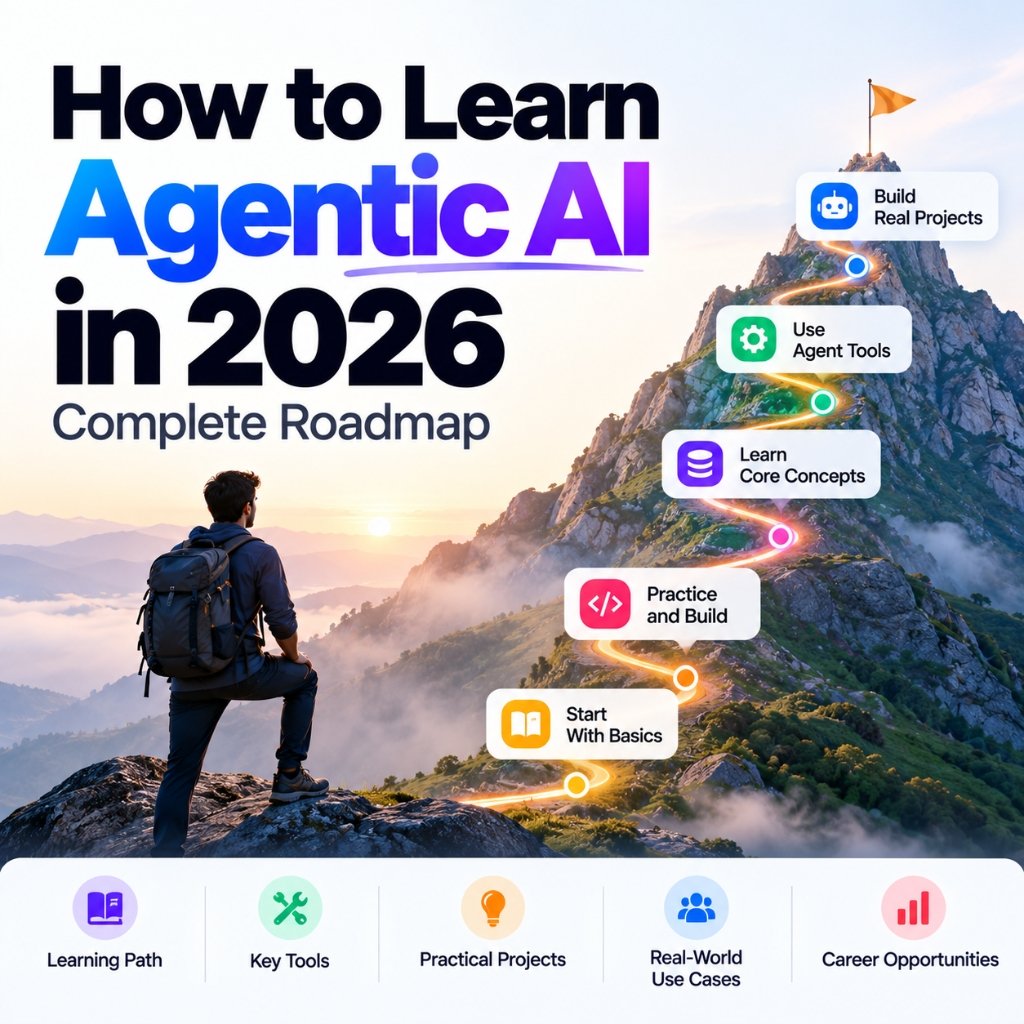
In this beginner-friendly guide, we’ll walk through how to learn Agentic AI step by step in 2026, including the essential skills, popular frameworks, useful tools, practical projects, and learning resources that can help you move from understanding the basics to building your own AI agents.
Why You Should Learn Agentic AI Today
The generative AI landscape has rapidly transitioned from novelty demonstrations to commercial operations. Organizations no longer want simple text generation tools that produce conversational drafts requiring tedious human proofreading. Instead, leadership teams seek autonomous agents that can audit financial reports, triage GitHub issues, reconcile customer billing discrepancies, and monitor multi-cloud infrastructure around the clock.
When you learn agentic AI, you bridge the crucial gap between probabilistic model outputs and deterministic software systems. Foundation models provide cognitive reasoning capabilities, but autonomous agents require structured execution loops, persistent memory, and rigorous guardrails to operate safely in production. Mastering these concepts transforms you from a prompt tinkerer into an indispensable systems engineer capable of deploying dependable automation across high-stakes industries.
Core Architectural Foundations Every Learner Must Master
Before diving into complex multi-agent orchestration frameworks, you must establish a solid conceptual foundation. To learn agentic AI effectively, focus on the fundamental building blocks that govern how autonomous agents operate:
1. Planning and Task Decomposition
Autonomous agents rarely solve complex objectives in a single execution step. You must understand planning paradigms such as Chain-of-Thought (CoT), Tree of Thoughts (ToT), and ReAct (Reasoning + Acting). These architectural patterns enable an agent to break down an abstract prompt into granular, verifiable sub-tasks before executing external operations.
2. Tool Calling and Function Execution
An agent without external tools is merely a conversationalist. Modern models interact with the digital world through structured JSON outputs that trigger database queries, API endpoints, web scraping, and file system operations. Understanding schema validation with Pydantic and managing asynchronous API calls is vital when building reliable autonomous software.
3. Persistent Memory and State Management
Real-world enterprise tasks require contextual continuity. You need to grasp how short-term memory (working context windows) and long-term memory (vector databases, graph databases, and relational stores) interact. Knowing when to summarize chat histories, store persistent user profiles, or retrieve historical interactions via semantic search ensures your agents stay aligned over multi-turn sessions.
4. Guardrails and Evaluation Frameworks
Unchecked autonomous systems can enter infinite execution loops, rack up enormous API token bills, or execute unauthorized mutations. Learning how to implement circuit breakers, deterministic verification steps, and human-in-the-loop approval gates is non-negotiable for enterprise deployments.
The Complete Roadmap to Learn Agentic AI Step-by-Step
Navigating the flood of tutorials and libraries can feel overwhelming. Follow this structured roadmap to systematically build your skills from fundamental mechanics to production deployment.
Phase 1: Python and API Fundamentals
Ensure your core software engineering foundations are solid. Master modern asynchronous Python (asyncio), object-oriented programming, and API integration using libraries like HTTPX and FastAPI. You should feel completely comfortable working with JSON schemas, handling API rate limits, and implementing structured logging across distributed services.
Phase 2: Core Prompt Engineering and Function Calling
Experiment directly with foundation model APIs like OpenAI, Anthropic Claude, and Google Gemini. Build hands-on scripts that enforce structured outputs using tool-calling schemas without relying on high-level abstractions. Gaining an intuitive understanding of raw tool payloads will make downstream debugging substantially easier when working with advanced frameworks.
Phase 3: Framework Specialization (LangGraph, CrewAI, AutoGen)
Once you understand raw API mechanics, adopt purpose-built orchestration libraries. If you want to build cyclic, graph-based state machines with precise execution control, master LangGraph. If your goal is role-playing multi-agent collaboration with intuitive delegation, explore CrewAI. For complex multi-party conversational agents, investigate Microsoft AutoGen. Experimenting with each framework helps you select the right architectural tool for specific enterprise requirements.
Phase 4: Local Models and Edge Deployment
Enterprise clients increasingly demand private, on-premise execution to safeguard proprietary corporate data. Learn how to run open-weight models (like Llama, Mistral, and Qwen) locally using Ollama and vLLM. Mastering quantized models and local vector indexing prepares you to build air-gapped, privacy-compliant architectures for security-conscious organizations.
Best Projects to Build as You Learn Agentic AI
Passive consumption of documentation will only take you so far. To solidify your expertise and create an impressive portfolio that catches the attention of tech recruiters and clients globally, build these three practical projects:
- Autonomous Research and Synthesis Agent: Build an agent that takes a complex topic, executes parallel web searches, scrapes relevant articles, filters out low-quality sources, and compiles an executive summary with hyperlinked citations.
- Automated Customer Operations Copilot: Develop a multi-agent system where one agent classifies inbound support tickets, a second queries a vector database for product knowledge, a third checks user account status via a mock SQL database, and a supervisor agent reviews the final response before dispatching.
- Code Review and Refactoring Agent: Construct a workflow that pulls code diffs from GitHub pull requests, runs static linting checks, identifies potential security vulnerabilities, and posts annotated inline comments directly to the development branch.
Also Read: If you’re planning to learn Agentic AI and build your own AI agents, choosing the right tools can make a big difference. The good news is that you don’t always need expensive AI platforms to get started. Many open source AI tools allow you to experiment with AI models, automate workflows, and develop intelligent applications with greater flexibility and control. To explore your options, check out our guide on the Best Open Source AI Tools in 2026, where we cover useful tools, their features, and how developers and beginners can use them for real-world AI projects.
Frequently Asked Questions (FAQ)
Q: Can beginners learn agentic AI without a computer science degree?
Yes, beginners can enter the field without a formal computer science degree. If you possess basic Python programming skills and understand how REST APIs communicate, you can leverage intuitive orchestration libraries and visual tools like n8n or Flowise to build sophisticated autonomous workflows.
Q: What programming language is best to learn agentic AI?
Python is undeniably the industry-standard language for autonomous agent development due to its rich ecosystem of libraries including LangChain, LangGraph, CrewAI, LlamaIndex, and Hugging Face. While TypeScript and JavaScript frameworks are growing quickly for web-based implementations, Python remains the dominant language across enterprise deployments worldwide.
Q: How long does it take to learn agentic AI thoroughly?
If you already have intermediate programming experience in Python, you can master the core fundamentals within four to six weeks of dedicated study. Reaching proficiency in production-grade concepts—such as multi-agent state machines, guardrails, and telemetry evaluation—typically takes three to four months of consistent hands-on project building.
Q: What are the biggest mistakes learners make with autonomous agents?
The most common mistake is relying on high-level abstraction libraries without understanding the underlying API calls, token limits, and prompt mechanics. Another frequent pitfall is neglecting deterministic guardrails, resulting in brittle agents that fail or hallucinate when encountering unexpected real-world inputs.