
Key Takeaways
- It is the first model in Google’s Gemini 4 family, announced on September 30, 2026.
- It raises the output ceiling to 1 million tokens, up from 64,000 in previous models.
- It is built for long-horizon work: software engineering, financial research, legal drafting, and defensive cybersecurity.
- Access started with vetted cyber defenders, then widened to developers and enterprises via Google Cloud and AI Studio.
- Introductory pricing is $2 per million input tokens and $10 per million output tokens.
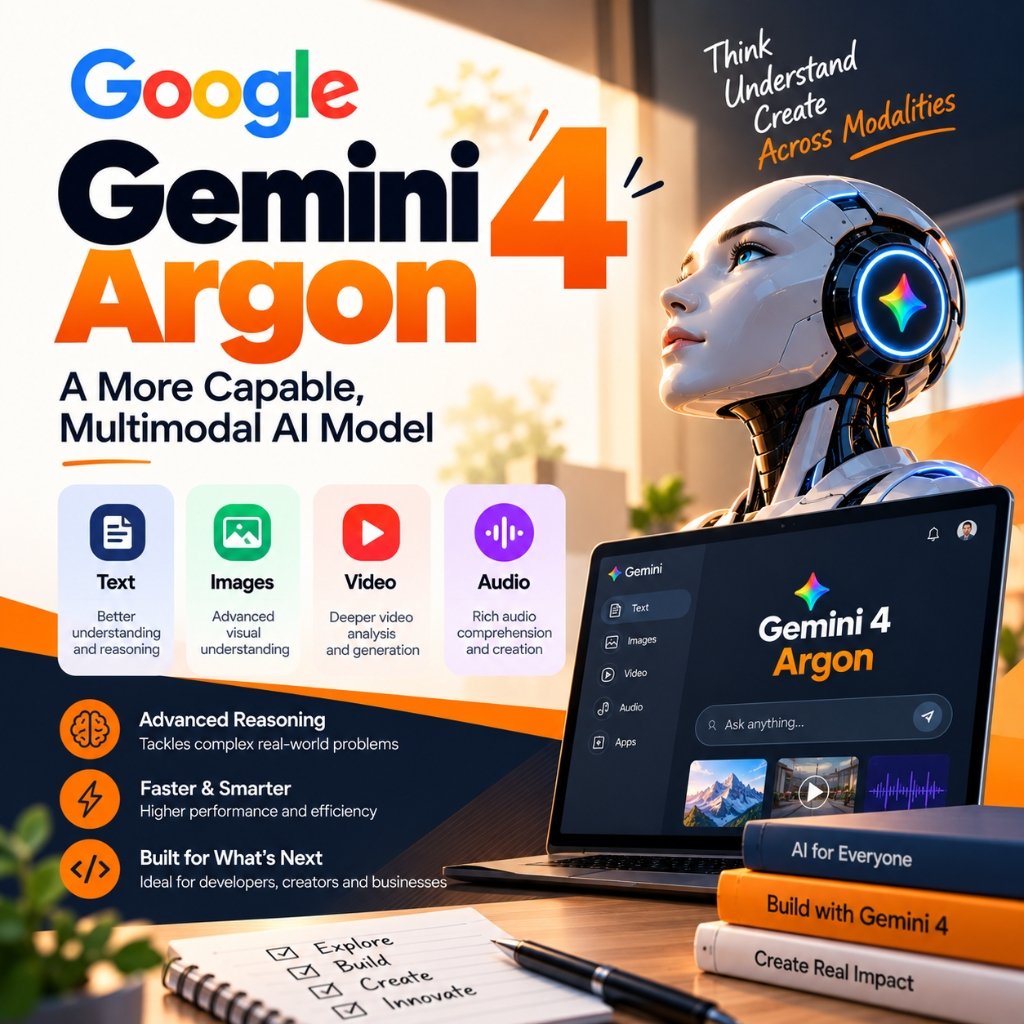
Google’s newest flagship model, Gemini 4 Argon, marks the opening chapter of the company’s Gemini 4 generation. Announced on September 30, 2026, it is not a small refresh of the Gemini 3 line. It is a purpose-built reasoning engine aimed at the hardest, longest tasks a professional can hand to an AI — writing and migrating code across massive repositories, running multi-step financial research, drafting legal documents, and hunting down software vulnerabilities before attackers find them. If you build software, manage an enterprise AI budget, or simply want to know where frontier models are heading, this guide breaks down what the model actually is, what it can do, and how you can get access.
What Is Gemini 4 Argon?
Gemini 4 Argon is a frontier large language model developed by Google DeepMind. Koray Kavukcuoglu, SVP at Google DeepMind and Chief AI Architect at Google, introduced it as a model “built to sustain deep reasoning across complex, long-horizon workflows.” That phrase is the whole thesis. Earlier models were optimized to answer a question well. Argon is optimized to stay coherent and productive across a task that unfolds over hundreds of steps — the kind of work that previously fell apart after the first dozen decisions.
The most visible technical leap is the output limit. Argon can generate up to 1 million tokens in a single response, a dramatic increase from the 64,000-token ceiling of prior models. In practical terms, that means the model can plan, draft, revise, and deliver an enormous artifact — a full code migration, a long research memo, a detailed legal analysis — without running out of room mid-task. It is a structural change in what a single prompt can accomplish, not just a bigger number on a spec sheet.
Why “Argon” and Why a Phased Launch
Google named the model after argon, the noble gas known for stability and reluctance to react. The metaphor fits a model designed to hold steady across long, complex workflows. It also reflects Google’s cautious rollout strategy. Because Argon is unusually capable at cybersecurity — including autonomously finding, validating, and patching critical software vulnerabilities — the company chose a staged release rather than an immediate public launch.
What Gemini 4 Argon Can Do
The model’s strengths cluster into four domains, each validated on public benchmarks and Google’s internal workloads.
Software engineering at scale
Argon scored 77.9 percent on DeepSWE v1.1, a benchmark that tests long-running software development tasks. Internally, Google is already using Argon-powered agents to migrate C and C++ codebases to Rust, scaling from core libraries like re2 and libgav1 up to more than 800,000 lines of the Fuchsia Zircon kernel. All of those changes still pass through human and automated review, but the volume of work the model can carry is the headline.
Financial and legal knowledge work
On domain-specific evaluations, including Vals Finance Agent v2 for multi-step financial research and Harvey’s Legal Agent Benchmark for legal research and drafting, Argon showed leading performance. These are the tasks where hallucination is most expensive, so the model’s ability to keep facts straight across long documents matters more than raw fluency.
Defensive cybersecurity
Argon was trained to be exceptionally strong at cyber defense. In Google’s evaluations, it identified 100 percent of top-priority vulnerabilities with zero fabricated vulnerabilities across verified claims. That precision is the difference between a useful security tool and a liability.
Enterprise workflows
In early access, Argon delivered roughly 20 percent improved task success over Gemini 3.8 Flash, with standout gains in HR and customer service scenarios. Thousands of Google employees already use it daily for coding, research, and writing.
Benchmarks and Real-World Results at a Glance
| Capability | Result | Context |
|---|---|---|
| Long-horizon coding | 77.9% on DeepSWE v1.1 | Long-running software development tasks |
| Task success vs. Gemini 3.8 Flash | ~20% improvement | Early access, HR and customer service |
| Vulnerability detection | 100% of top-priority issues found | 0% fabricated vulnerabilities |
| Code migration | 800K+ lines of Fuchsia Zircon kernel | C/C++ to Rust conversion |
| Infrastructure efficiency | 330 TB of RAM freed | Optimizations found by Argon agents |
| Prompt-injection robustness | Leading score on Gray Swan’s IPI benchmark | Via automated red teaming |
One internal example stands out: a group of AI agents identified optimizations that, once implemented in Google’s data centers, freed up more than 330 terabytes of RAM. That is not a marketing metric — it is a measurable operational saving produced by the model doing real engineering work.
Gemini 4 Argon Pricing and Availability
Access rolled out in phases. Gemini 4 Argon first reached a set of trusted cyber defenders through the Fairwind Program, a limited-access initiative run by Google DeepMind and Google Cloud, while Google engaged with the U.S. government’s voluntary pre-release model review process. From there, access widened to paid API customers and Google AI Ultra subscribers, and on October 13, 2026 the model became globally available to developers and enterprises through Google Cloud, Google AI Studio, and the Gemini platform under the model ID gemini-4-argon.
Pricing is competitive for a frontier model. During the introductory period, the model costs $2 per million input tokens and $10 per million output tokens, with cached input tokens priced at a 95 percent discount off the standard input rate. After the introductory window, rates rise to $4 per million input tokens and $20 per million output tokens. For teams running large, repetitive workloads, the cached-input discount is often the most important line on the pricing sheet, because it can cut the cost of long, reused contexts dramatically.
Who should care right now
If you are a developer shipping production software, Argon’s long-horizon coding strength is the main draw. If you run finance or legal operations, the domain benchmarks are worth a pilot. If you are in security, Argon is being positioned as a defensive tool that finds and patches flaws at machine speed. And if you are simply tracking the frontier, Argon is a signal that the competitive battle has shifted from “how smart is the model” to “how long can the model stay useful.”
How Gemini 4 Argon Fits Into the AI Landscape
The jump from 64,000 to 1 million output tokens is not a cosmetic upgrade. It changes the unit of work. Instead of asking a model to summarize a document, you can ask it to read a codebase, plan a migration, execute it in stages, and verify the result — all within one sustained session. That shift is why the industry has moved toward “agents” rather than chat, and it is exactly where the model is aimed.
Google is also being deliberate about safety. Through automated red teaming and adversarial training, the model leads on Gray Swan’s Indirect Prompt Injection benchmark, a measure of how resistant it is to malicious instructions hidden in the data it processes. For trusted defenders and Google’s own internal teams, the company is releasing Argon without cyber guardrails so they can use its full defensive capability — a deliberate trade-off that explains why the launch was phased rather than open from day one.
If you’re tired of generic AI copy that ignores your brand voice, the real fix isn’t a better one-off prompt — it’s a reusable system prompt. Our guide to the best system prompts for digital marketers breaks down five copy-paste templates for Meta and Google ads, email drip sequences, SEO/GEO articles, short-form video hooks, and WhatsApp lead qualification, plus how to deploy them across ChatGPT, Claude, and Ollama. It’s a practical starting point for anyone who wants consistent, high-converting output instead of re-explaining the same instructions every time.
The Bottom Line
Gemini 4 Argon signals where frontier AI is going: not just smarter answers, but longer, more autonomous work. Its 1 million token output ceiling, its benchmark-leading performance in coding and cyber defense, and its aggressive introductory pricing all point to a model designed for professionals who need an AI to carry a task to completion rather than start it. If your workflows involve large codebases, dense research, or high-stakes drafting, it deserves a place on your evaluation shortlist. The era of the long-horizon model has arrived — and Argon is Google’s opening move.
Frequently Asked Questions
Q:What is Gemini 4 Argon? It is Google’s first Gemini 4 model, a frontier AI system built for long-horizon reasoning across coding, financial research, legal drafting, and cybersecurity defense.
Q: When was it released? Google announced it on September 30, 2026, and made it globally available to developers and enterprises on October 13, 2026.
Q: How much does it cost? Introductory pricing is $2 per million input tokens and $10 per million output tokens, with cached input tokens at a 95 percent discount. Standard pricing later rises to $4 and $20 respectively.
Q: What is the 1 million token limit for? The expanded output ceiling lets the model complete very long tasks — large code migrations, lengthy research reports, and multi-step analyses — in a single sustained session.
Q: Can anyone use it? Yes. After an initial rollout to vetted cyber defenders and then paid API customers and AI Ultra subscribers, it is now available broadly through Google Cloud, Google AI Studio, and the Gemini platform.
Q: Is it safe? Google reports leading robustness on indirect prompt-injection benchmarks and released the model in phases, with additional safeguards before broad public availability.