
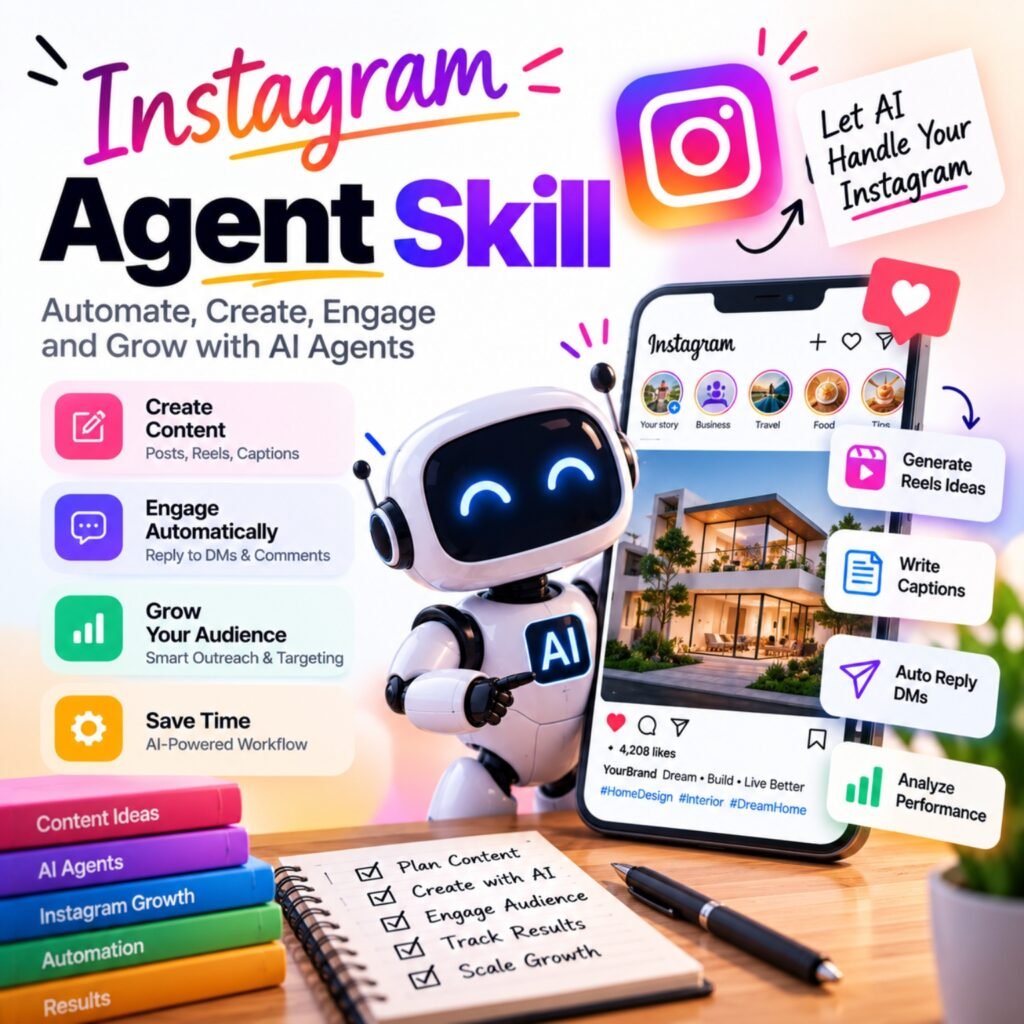

An instagram agent skill is a packaged set of instructions that lets an AI agent plan, create, publish, and measure Instagram content on your behalf. If you manage a brand account, you already know the daily grind: brainstorm a Reel idea, write a caption, hunt for hashtags, schedule the post, answer a dozen DMs, and then try to work out what actually drove results. It compresses that entire loop into a workflow an AI can run reliably, at scale, and around the clock.
Key Takeaways
- This kind of skill turns a general-purpose AI agent into a capable Instagram operator by defining its tools, inputs, and guardrails.
- The strongest skills combine content creation, scheduling, engagement automation, and analytics in one repeatable pipeline.
- Skills work through Meta’s official APIs, so they respect platform rules far better than legacy “growth hacking” bots.
- The winning strategy is human-in-the-loop: let the agent draft and execute, but keep brand voice and final approvals under human control.
What Is an Instagram Agent Skill?
Think of an AI agent as a talented new hire with broad general knowledge but no specific onboarding. An instagram agent skill is that onboarding. It is a plain-text or structured instruction file—often a SKILL.md, a set of API definitions, and a few guardrails—that teaches the agent exactly which Instagram actions it can take, what data it should gather first, and what it must never do.
The concept exploded in late 2025 alongside tools like Claude Code, OpenAI Codex, and agentic IDEs. The pattern is deliberately simple: give the agent a documented capability, and it can suddenly operate a platform it was never explicitly trained on. For Instagram, that capability usually covers reading profile and media data, creating photo, Reel, and Story containers, checking processing status, and publishing once a human or a rule approves.
How AI Agent Skills Work Under the Hood
Most production-grade skills sit on top of the official Instagram Graph API and the broader Meta developer platform. That matters, because it separates a legitimate agent from the automated bots that violate platform terms and get accounts flagged.
The anatomy of a skill
A well-built skill typically contains four layers:
- Capability definitions — the exact functions the agent can call, such as “publish image,” “list media,” or “read insights.”
- Input schema — the fields each action expects, so the agent knows what a valid request looks like.
- Guardrails — limits on frequency, content type, and topics that require escalation.
- Context files — brand voice guides, product facts, and approved hashtag sets the agent draws on.
From prompt to published post
When you ask the agent to “post a carousel about our summer sale,” it does not simply hallucinate a caption. It reads the skill, checks which actions are available, drafts the copy against your brand context, creates the media container, waits for Instagram to finish processing, and then publishes. Each step is logged, so you can audit what happened and why.
Core Capabilities Every Instagram Agent Skill Should Have
Not all skills are equal. The best ones cover the full lifecycle of an account rather than a single narrow task.
Content creation and ideation
The agent should generate captions, hook variants, hashtag sets, and content calendars. It can analyze trending topics in your niche, study competitor accounts, and propose post ideas with a clear angle and call to action.
Scheduling and publishing
Good skills publish at the times your audience is actually active. They support photos, Reels, Stories, and carousels, and they respect rate limits so your account stays in good standing.
DM and comment automation
This is where automation earns its keep. The agent can greet new followers, answer common product questions, qualify leads, and escalate complex conversations to a human—all within Meta’s messaging policies.
Analytics and reporting
Finally, the skill should close the loop. It pulls reach, engagement, follower growth, and conversion data, then translates those numbers into plain-language recommendations for the next content cycle.
Why Marketing Teams Benefit from Instagram AI Agents
The appeal is not just speed; it is consistency. A human social manager has good days and rushed days. An agent executes the same quality bar every time. That reliability is the real reason an instagram agent skill pays for itself.
For lean teams and solo founders, the math is compelling. A single agent can manage multiple accounts, respond to messages within seconds, and produce a month of content in an afternoon. Agencies use skills to standardize how every client account is run, which reduces training time and keeps quality predictable across the portfolio.
There is also a strategic benefit. Because the agent logs every action and outcome, you build a growing dataset of what works for your specific audience—something generic schedulers never provide.
How to Build or Choose an Instagram Agent Skill
You have two realistic paths: adopt an existing skill from a marketplace, or build your own against the API.
Step 1: Define the job to be done
Start with one painful, repetitive task—say, replying to product questions in DMs. A focused first skill is easier to test and far less risky than a do-everything agent.
Step 2: Connect official access
Use Instagram Business or Creator accounts through Meta’s API. Avoid any tool that asks for your password or promises mass following; those are the fastest route to a ban.
Step 3: Add brand context and guardrails
Feed the agent your tone of voice, banned phrases, approved claims, and escalation rules. Then set hard limits on posting frequency and automated replies.
Step 4: Test with human review, then expand
Run the agent in “draft and approve” mode for the first few weeks. Once its output consistently matches your standards, gradually hand over more autonomy.
Instagram Agent Skill vs Traditional Automation Tools
Traditional schedulers are calendars with a send button. Rule-based automation tools follow rigid if-then flows that break the moment a customer asks something unexpected. A true agent skill is different because the underlying model understands context, intent, and language.
That flexibility shows up in conversation. A rule-based bot fails when someone types a typo or switches languages. An agent trained on your knowledge base handles the same message gracefully, in one of 95+ supported languages, and knows when to hand off to a person. The trade-off is control: agents are less predictable than rigid flows, which is exactly why guardrails and human review matter.
Best Practices and Common Pitfalls
Getting value from an instagram agent skill is mostly about discipline.
- Keep automation authentic. Audiences punish robotic replies. Have the agent write in your real voice and vary its phrasing.
- Respect platform rules. No mass-following, no spammy comment blasts, no buying engagement. Compliance is not optional.
- Always keep a human in the loop for sensitive topics. Pricing disputes, complaints, and crisis moments need a person.
- Measure against a baseline. Track engagement and conversion before and after automation so you know it is actually helping.
- Refresh the knowledge base. An agent is only as current as the facts you feed it.
The most common mistake is over-automation. Teams hand over everything at once, quality drops, and they blame the technology. Start narrow, measure honestly, and scale what works.
The Future of AI Agent Skills
Skills are becoming the default way agents learn new platforms. We are moving from “here is a tool” to “here is a documented capability the agent can reason about and combine with others.” Expect to see these skills coordinate with ad-platform and email capabilities, so a single instruction like “launch our summer campaign” flows from creative generation to paid promotion to follow-up messaging.
The teams that win will not be the ones with the most automation. They will be the ones that pair capable agents with sharp strategy and genuine brand voice.
Wrapping Up
An Instagram agent skill is not a magic growth button. It gives a capable AI the tools, context, and guardrails it needs to handle Instagram work reliably. The same principle applies to any scheduling tool for Instagram: the software only compounds your results when you set it up with care.
Start with one repetitive task, such as scheduling a week of posts or drafting captions. Connect it through official APIs, as Meta Business Suite does, rather than tools that ask for your password. Keep a human in the loop for replies, comments, and DMs, and expand the automation as you build trust in it. Do that, and a time-consuming channel becomes a system that compounds.
Ready to go further? Here are three next steps:
- Make your visuals stand out: Before you schedule your next batch, learn how to generate images using AI for scroll-stopping posts.
- Turn followers into customers: See how to build funnels with AI tools so your Instagram traffic leads to real conversions.
- Build smarter automation: If agent skills interest you, follow the Agentic AI learning roadmap, or browse more guides in our AI Automation category.
Frequently Asked Questions
Q: What exactly is an Instagram AI agent skill?
It is a structured instruction set that tells an AI agent which Instagram actions it can perform, what inputs those actions need, and what rules it must follow. It effectively onboards a general AI agent onto Instagram.
Q: Do I need coding skills to use one?
Not necessarily. Many marketplace skills are ready to install and configure. Building a custom skill against Meta’s API does require some technical work, but no-code platforms increasingly handle the setup for you.
Q: Is Instagram automation safe for my account?
Yes, when it uses official Instagram Business or Creator APIs and follows platform policies. Avoid any tool that requests your password or promises mass following—those approaches risk account restrictions.
Q: Can an AI agent handle DMs and comments?
It can greet followers, answer common questions, qualify leads, and escalate complex conversations to a human. This is one of the highest-value uses of an Instagram AI agent for growing businesses.
Q:How much time can automation realistically save?
Teams commonly report saving several hours per week per account on content drafting, scheduling, and routine replies, while keeping human review for high-stakes messages.
Q:Will automated content hurt engagement?
Only if it feels generic. Keep the agent trained on your brand voice, vary phrasing, and review performance data regularly to ensure posts still resonate with your audience.