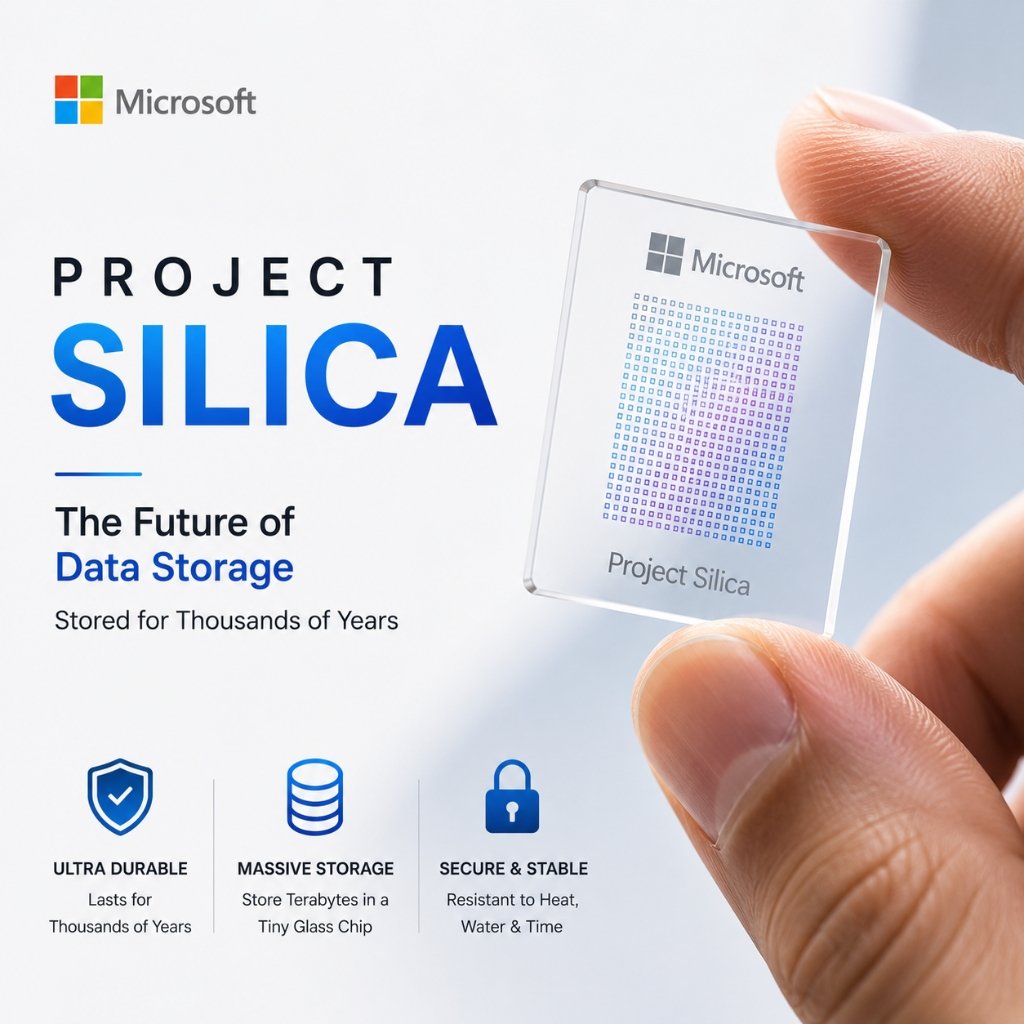

Microsoft Project Silica is changing the way we think about data storage forever — and it starts with something as simple as a piece of glass. Every photo you’ve ever taken, every document you’ve ever saved, every piece of data your hospital has ever recorded — all of it sits on magnetic tape or hard drives that will likely degrade within a decade. Microsoft thinks glass is the answer. And they might just be right.
We live in an age of almost incomprehensible data creation. By some estimates, the global data storage market was valued at $255 billion in 2025 and is projected to swell to nearly a trillion dollars by 2034. Yet the technology we rely on to store all of this information — spinning hard drives, magnetic tape, SSDs — remains fragile, energy-hungry, and surprisingly short-lived. Magnetic media degrades. Tapes need climate-controlled environments. Hard drives crash. And the cost of continuously migrating data from one dying medium to the next adds up to staggering amounts of money and carbon emissions.
That’s the problem Microsoft Project Silica was built to solve. And after nearly a decade of research, the team is closer than ever to turning science fiction into infrastructure reality.
What Exactly Is Project Silica?
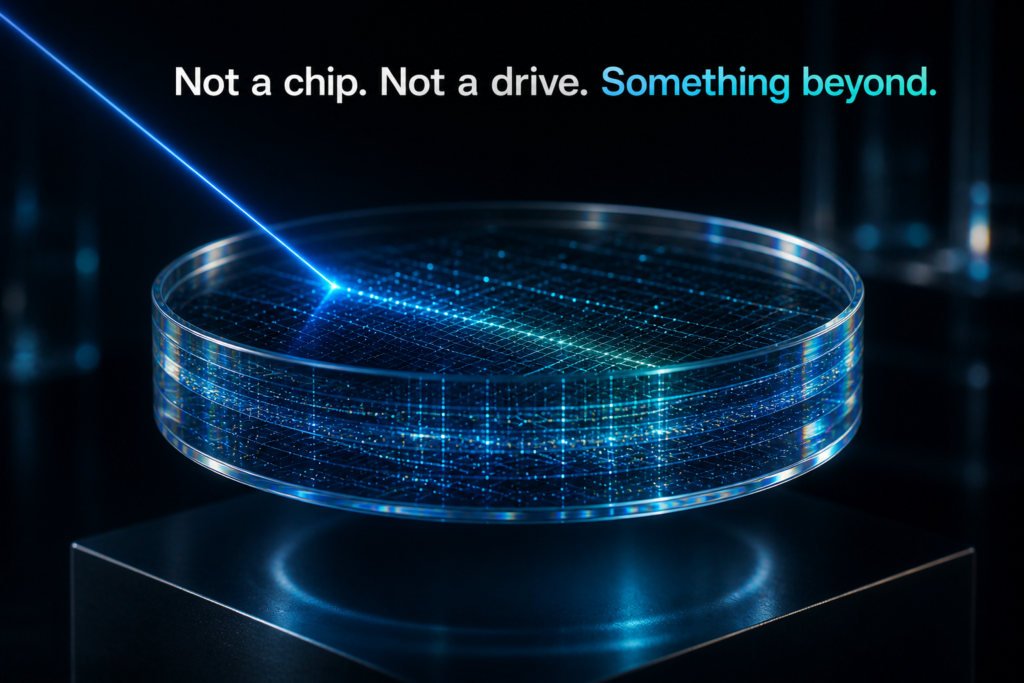
At its core, Project Silica is Microsoft Research’s attempt to build the world’s first storage technology designed from the ground up for ultra-long-term data preservation. The medium? Ordinary glass. The method? Ultrafast femtosecond laser pulses that physically alter the structure of the glass at a microscopic level.
Here’s how it works: a femtosecond laser — a laser that fires pulses measured in quadrillionths of a second — etches tiny three-dimensional marks called voxels (think of them as 3D pixels) deep inside a glass plate. These marks are arranged in hundreds of layers throughout the full 2mm thickness of the glass. To read the data back, a computer-controlled polarization-sensitive microscope scans the glass and an AI-powered decoder interprets what it finds.
The result is a WORM storage medium (Write Once, Read Many) that is physically impossible to accidentally overwrite during reading — there simply isn’t enough power in the reading light to alter the glass. Once written, the data is locked in permanently.
Key numbers at a glance:
- 4.8 TB of data stored per coaster-sized glass plate
- 300 data layers packed into a sheet just 2mm thick
- Data preservation tested to last over 10,000 years
- Glass survived repeated heating up to 500°C in stability tests
Microsoft Project Silica, The Borosilicate Breakthrough That Changes Everything
For years, the biggest barrier to commercializing glass-based data storage was the material itself. The original technique only worked with fused silica — an extremely pure, high-quality glass that is difficult to manufacture and costs up to three times more than common alternatives. That’s a hard sell when you’re trying to compete with magnetic tape at scale.
In early 2026, published in the journal Nature, Microsoft announced a major breakthrough: the technology now works with borosilicate glass — the same inexpensive material found in your kitchen cookware and oven doors. This single development fundamentally changes the economics of the entire project.
“Glass is a permanent data storage material that is resistant to water, heat, and dust. Our results demonstrate that Silica could become the archival storage solution for the digital age.” — Microsoft Research Team, Nature Publication, 2026
Alongside the material switch, the team introduced two new types of voxels — phase voxels and birefringent voxels — each requiring only a single laser pulse to write, compared to the many pulses previously needed. This dramatically reduces power consumption and speeds up the writing process. In parallel, the reading hardware has been simplified from three cameras down to one, cutting both cost and complexity.
Why Current Storage Solutions Are Failing Us
The urgency behind Microsoft Project Silica becomes clearer when you understand the scale of the problem. Humanity is generating data at a rate projected to exceed hundreds of zettabytes annually. Medical records, climate data, scientific research, cultural archives, AI training datasets — all of it needs somewhere to live, ideally for a very long time.
But conventional long-term data archival solutions like LTO magnetic tape typically last only 10–30 years under ideal conditions. They require constant energy for climate control, periodic migration to new formats, and significant human oversight. The total cost of ownership over a century is enormous. The carbon footprint is significant.
Glass, by contrast, needs no air conditioning, no dehumidifiers, no magnetic shielding. Once data is written, the ongoing cost is, as one Microsoft engineer put it, “basically warehouse space.” The glass can survive being baked, flooded, demagnetized, or exposed to extreme temperatures without losing a single bit. It is electromagnetic field-proof by design.
Real-World Applications Already Taking Shape
The real-world impact of Microsoft Project Silica is already moving beyond the laboratory. Real organizations are exploring its potential at a serious scale. The Global Music Vault in Svalbard, Norway — a sustainability-focused effort to preserve the world’s musical heritage — has partnered with Microsoft Research to archive recordings on silica glass plates. It joins an earlier, headline-grabbing demonstration in which the entire 1978 film Superman was stored on a single coaster-sized glass slide.
Warner Bros. was among the first major industry partners to assess the technology for preserving its vast media library. According to the studio’s then-CTO, Vicky Colf: “If Project Silica’s storage solution proves to be as cost-effective and scalable as it could be, this is something we’d love to see adopted by other studios and industries.”
Beyond media and entertainment, Microsoft Project Silica has drawn serious interest from government archival agencies, national libraries, large-scale scientific research institutions, and AI training data repositories — any use case where data must be written once and reliably retrieved decades or even centuries later. The technology is no longer a question of whether it works. The question now is simply how fast it can scale.
📖 Also Read: Warning: Anthropic Claude for Small Business Is the Unfair Advantage Your Competitors Already Have Discover how Anthropic Claude is helping small businesses create better content, analyse customer feedback, and outpace competitors — all for just $20/month.
The Road to Commercial Viability
Despite the excitement around Microsoft Project Silica, it’s worth being clear-eyed: this is not a replacement for your SSD. Write speeds are currently measured in megabits per second — orders of magnitude slower than conventional hard drives. The femtosecond lasers required for writing remain expensive, often costing hundreds of thousands of dollars per unit. And Microsoft has yet to publicly disclose detailed metrics on cost-per-terabyte or retrieval latency at scale.
The roadmap, however, is well-defined. Analysts expect pilot deployments in specialized government and scientific applications between 2025 and 2027, with more integrated cloud-based glass storage offerings emerging by 2030. Microsoft’s Azure team is already involved in co-designing the hardware and software stacks — including novel robotic library systems that automate glass media handling at datacenter scale.
The company is also working to make the entire system self-describing: every piece of glass written by Microsoft Project Silica contains enough embedded information — including AI model training data — to allow any future system to decode it entirely from scratch. In other words, the glass doesn’t just store your data. It stores the instructions for how to read itself. That’s a level of archival foresight no previous storage medium has ever achieved.
The Bigger Picture: Preserving the Digital Age
There’s something quietly profound about what Microsoft Project Silica represents. We are the first civilization to generate truly vast amounts of digital information, yet we’ve built that civilization on storage media that begins degrading the moment it’s manufactured. The irony is stark.
Writing, as a technology, is only about 5,000 years old. The idea that a single piece of glass the size of a drinks coaster could hold 4.8 terabytes of data — intact — for 10,000 years puts the entire span of recorded human history into perspective.
Microsoft Project Silica is not just a storage technology. It’s a statement about what we think is worth preserving, and how seriously we take the responsibility of handing the digital record of our era to those who come after us. Whether it becomes mainstream cloud infrastructure or remains a specialized tool for the world’s most critical archives, the glass revolution in data storage has quietly, durably, already begun.